
No One Owns the Learner Experience, And That's the Problem
Most L&D teams don't have a governance problem they can point to, but dozens of small ones that nobody owns. HR L&D runs leadership development. Sales enablement builds pipeline training. Product teams launch their own certification tracks. Customer education serves external audiences, and sits somewhere between marketing, L&D and customer success. Compliance mandates quarterly modules, but the content is rarely produced in-house. Each team is competent, well-intentioned, but building in isolation. And none are ultimately accountable for the learning experience across all audience groups and training platforms. This isn't an organizational structure gap, but a L&D operating model problem. And it's the single biggest structural challenge in corporate learning today.
The Enterprise Problem: Death by a Thousand Curricula
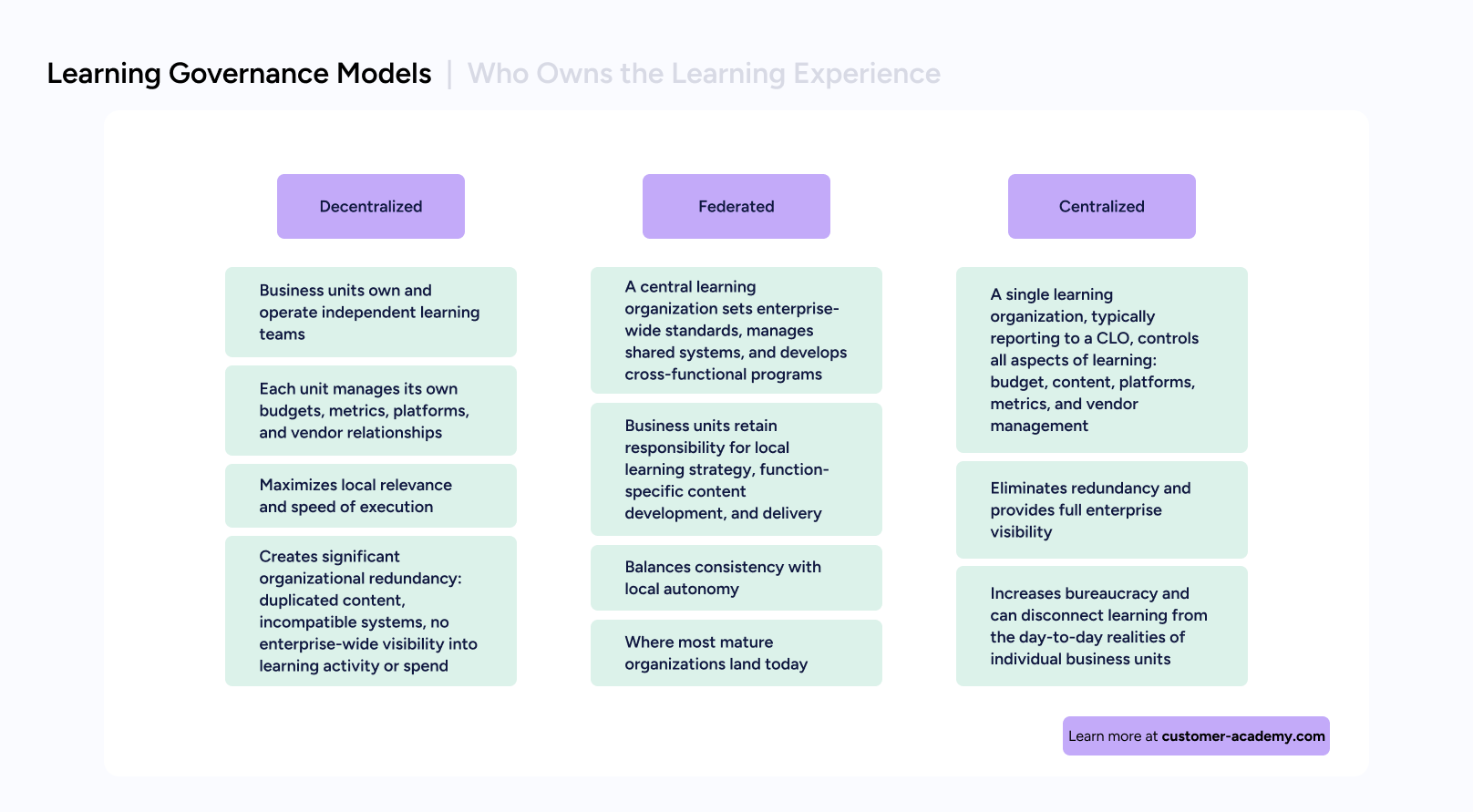
In large, decentralized enterprises (check out the chart below for a comparison between decentralized, federated and centralized companies), the symptoms are easy to spot. The same employee receives onboarding from HR, product training from a business unit, sales methodology from enablement, and compliance modules from legal; each built on different platforms, with different design standards, and zero awareness of what the others assigned that quarter. The learner experience isn't fragmented by accident. It's fragmented by architecture.
Meanwhile, resources stay siloed. One team builds roleplay exercises that another team doesn't know exist. Subject matter experts get tapped repeatedly by different departments for overlapping content. Budgets are allocated vertically within each function, so nobody can see the total organizational spend on learning, let alone whether it's working.
Without a shared operating model, training departments don't coordinate, they compete. They compete for the same calendar slots, the same audience attention, and the same finite reservoir of learner goodwill. The predictable outcome is what I call "next-next-next" behavior: employees clicking through completions to make the notifications stop. And here's what makes the governance gap so costly: it's not just about efficiency. Every irrelevant assignment erodes L&D's standing with the business, and every duplicated program signals that nobody is looking at the full picture. As Thomas Kupetis puts it, without structured governance, learning becomes a series of disconnected events rather than a strategic function that supports business growth.
The Startup Mistake: "We'll Figure It Out Later"
In a 50-person company with one L&D generalist, an operating model might sound like enterprise overhead. It isn't. The architectural decisions you make now: where training lives, who approves content, how you define "mandatory," who owns the learner experience end-to-end, become exponentially harder to retrofit at scale. Every department you allow to launch training independently is a silo you'll eventually need to reconnect. Every platform adopted without cross-functional input is a data island. Governance debt compounds silently until, one day, you're an organization with a dozen training functions and nobody can map what a new hire's first 90 days actually look like.
Start with something deceptively simple: a single document that maps who trains whom, on what, and when. That alone puts you ahead of companies ten times your size.
What Governance Actually Looks Like
Governance isn't bureaucracy and it isn't a central team vetoing content. Yes, it does enable a formal framework for managing decisions about learning and talent development, but it’s ultimately a mode for accountability, defining priorities, allocating budget and resources, driving actionable decision-making, and facilitating transformation. At its best, it's three layers working together: oversight that aligns learning investment to business priorities, structured relationships with every stakeholder group that touches the learner, and mechanisms for continuous improvement that keep the model from calcifying.
Think of it as a solid core with flexible edges; stable decision-making processes at the center, with enough adaptability that local teams can move fast without fragmenting the whole.
The organizations that get this right stop asking "did they finish the training?" and start asking "did anything change afterward?" That single shift transforms L&D from a cost center stakeholders tolerate into a strategic function the business relies on. And the bigger question isn't whether to centralize or decentralize. It's whether your model, whatever it is, covers the full spectrum from strategic to tactical, from global to local, from business needs to learner needs. A fully decentralized model where each business unit runs independent training teams increases organizational redundancy and creates data silos. A fully centralized model reduces duplication but increases bureaucracy and risks losing local context. The sweet spot for most organizations is a federated approach: a central body that sets standards and manages enterprise systems, with business units retaining responsibility for local strategy alignment and delivery. And most importantly, owns the full picture of what your learners actually experience.